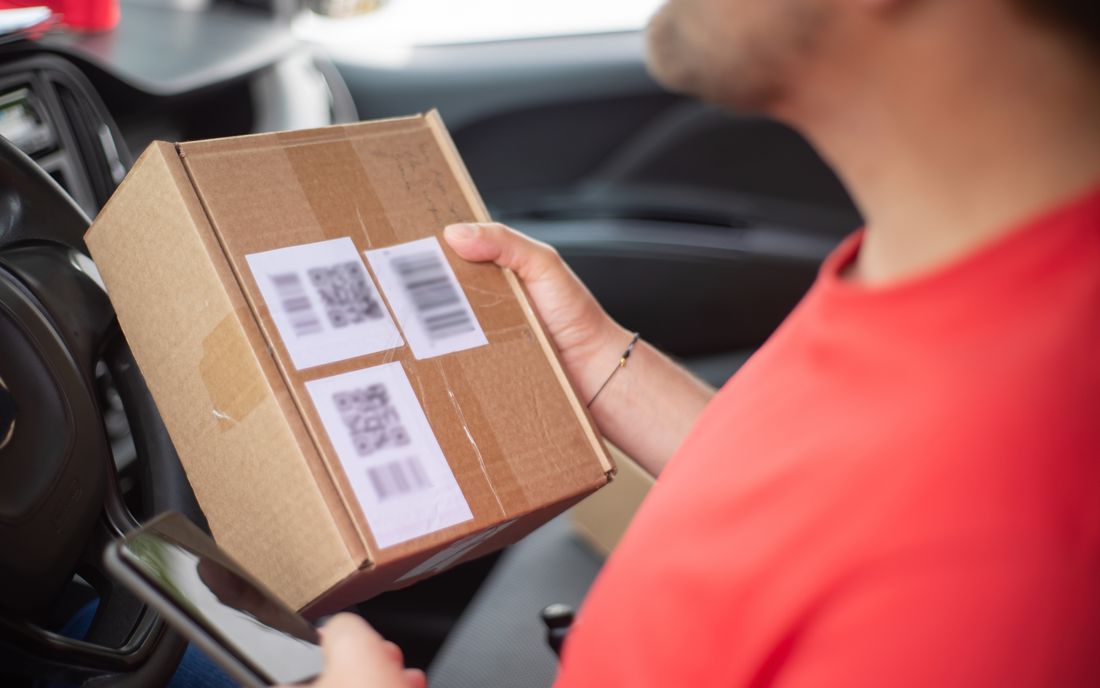
One-dimensional barcode or QR code for warehouse use
One-dimensional barcodes scan fast and print cheaply; QR codes hold more data but need better labels. Which suits bins, pallets and individual products?
A supplier offers to print a QR code on every carton, a colleague says to stay with plain barcodes, and someone else asks whether staff could simply scan the shelf labels with a phone. Each view has something to it, because this is not a question of which is more advanced. One-dimensional barcodes and QR codes each suit some labels in a warehouse, and the right choice reads faster, prints cheaper and lasts longer.
What each one is
A one-dimensional barcode is a row of vertical bars of different widths, read along a single line. Retail products carry EAN-13, which is of this kind, and Code 128, a common choice for internal warehouse labels, can hold letters and digits. It reads fast, almost every common scanner can read it, and an ordinary label printer prints it. Its weakness is capacity: longer content makes the code wider, and one scratch across all the bars can stop it reading.
A QR code and other two-dimensional codes are square patterns of small modules, read as an image. They hold more data in a small area, can be read from any angle and include error correction, so partial damage can still be read. The price is that you need a device that reads images, or a phone camera, and a print that is too small or too pale fails just the same.
Where each fits
- Retail products: keep the manufacturer's EAN-13 and do not replace it with your own.
- Bin and shelf labels: Code 128 with a short code such as B-A0103, printed as long, thick bars that scan from the aisle. If staff scan with phones, or the label space is tiny, QR is the better fit.
- Pallets and cartons: either works, provided the code holds only an ID. Encoding SKU, batch and quantity into a QR code is technically possible, but once the carton is opened the quantity changes and the label is out of date. Keep the content in a table and only the ID in the code, whichever type you choose. QR's advantage here is mainly damage tolerance and small size.
- Small items and parts bags: QR takes up little room, which suits small packs with hardly any free space.
- Customer-facing codes: for example a code that opens a Telegram chat or a product page. That is a marketing use, so design it separately from internal warehouse labels.
Check the devices before you order
Not every scanner reads two-dimensional codes, and some older ones read only one-dimensional barcodes. In a warehouse with mixed devices, QR codes on pallets mean those devices cannot read them. A phone with a scanning app reads both types, but for several hours of counting it is usually less comfortable than a dedicated handheld.
Before ordering large quantities, print one of each on the real label material and test it with the devices you use on site.
One code per label
A carton may carry the manufacturer's EAN, your own internal barcode and a QR code the supplier added. The device may read any of them, and the result is confusing. Decide beforehand which code the count uses, and mark it, for instance with a coloured border. Ignore the others.
Length matters more than type
Take a seven-character bin code in Code 128: a narrow strip is enough, and the bars can be thick enough to scan from an arm's length. Put 30 characters of SKU, batch and date into the same kind of code and the label has to be much wider, or the bars thinner, and thin bars are harder to read. The same 30 characters fit in a small QR square, but only if it is printed large and clearly enough.
So whichever type you choose, keep the content as short as possible, ideally just an ID.
In short
Keep the manufacturer's barcode on retail goods, use a short one-dimensional code for bins, use QR where small size or damage tolerance matters, and put only an ID in the code. InventoryHub numbers and prints labels for products, shelves and bins that have none, and the type of code can be agreed before the visit with your devices and site conditions in mind, so later receiving can keep using it.